Heavy-Handed, Apparently
“She sure do have a heavy hand.”
Well.
There it was.
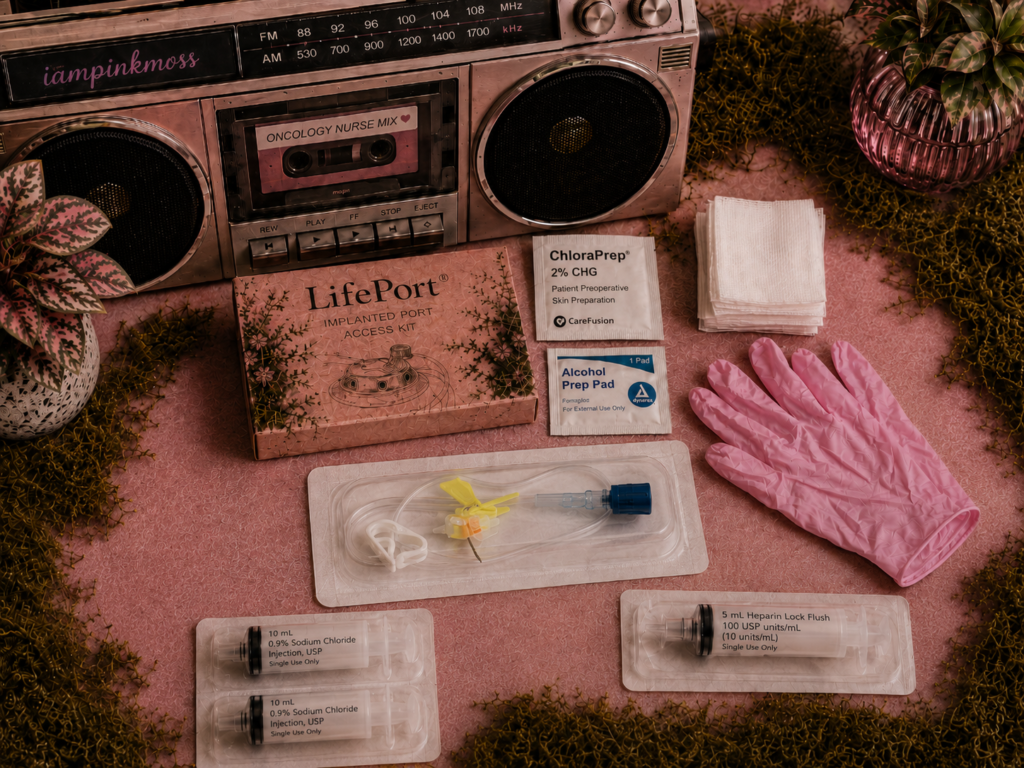
I was standing there accessing a newly implanted life port, doing something I have done thousands of times, and apparently I had just been promoted from oncology nurse to the Tasmanian Devil Nurse.
The port was new. The surgical dressing was still fresh. I removed the bandages, checked the incisions, noted that the skin glue was still smoothly intact, scrubbed the site, stabilized the port, counted to three, and inserted the needle quickly.
The patient flinched.
Not dramatically. Not in a way that made me think something had gone wrong. She flinched because a needle had just gone through her skin into a port that had been implanted a few days before.
I apologized anyway.
Blood returns immediately. One stick, uncomplicated, done. The way it should be.
Then I heard the family member say, almost to herself but plenty loud enough for the room to hear:
“She sure do have a heavy hand.”
Verbatim.
For a second, I honestly did not know what she meant.
I thought maybe she was talking about the way I was pressing down on the dressing because I was trying to make sure it sealed securely over the needle hub and extension tubing. So there I was, cheerfully explaining why I wanted the dressing to stick well and how we wanted to keep germs out, blah, blah, blah, because evidently my brain had decided that if I explained adhesive thoroughly enough, the awkward moment might disappear.
It did not.
A few moments later, the family member clarified.
“You did that so fast. It was so aggressive. I’ve never seen anybody do it so aggressively before.”
Aggressive.
There is a word you love hearing while standing over a patient with a needle in your hand.
The patient herself said it was fine, but the family member kept going.
And that was the part that got to me.
If the family member had said, “That looked like it hurt,” I would have understood.
If she had said, “Oh, my loved one jumped,” I would have said yes, she did.
And if the patient had said, “Ouch, you hurt me,” I would have apologized again and adjusted anything I needed to adjust.
But aggressive felt different.
Aggressive felt like a judgment of me, not the procedure.

Aggressive made it sound like I had spear-tackled this poor woman like I was trying to score the last spoon in a family game of Spoons.
And I know this sounds defensive because it is defensive, but I know how to access a port.
I have done it thousands of times. I have never been told I was rough or heavy-handed, and patients have even complimented my technique plenty of times.
However, none of that means I am incapable of hurting somebody.
Needles hurt.
New ports hurt.
People flinch, sometimes even when you do everything right.
But the word “aggressive” sat wrong with me.
Apart from that, the whole interaction had already felt a little off before I ever accessed the life port.
The patient and her family member did not want to sit in the community infusion area because it felt too open. The patient said, “I don’t feel comfortable in this open space.” They wanted a semi-private chair instead.
I TOTALLY get that.
Cancer treatment is intimate and miserable enough without sitting in a room full of other people while receiving treatment.
I apologized and explained that I would check with the charge RN for a possible workaround. The schedule was packed, though, and those apparently empty chairs were already assigned to patients who had not arrived yet.
This is where my halo slid a little crooked.
I felt irritated by the request, and I thought, “Well, yes, everybody would probably like the nicer chair… but why do you feel that your needs are of higher priority than any other patient’s?“
Yes, I thought that, and not for the first time, either, since I’ve been a nurse.
Maybe that irritation colored the rest of the encounter for me.
That is possible.
However, I sensed that the family member had been watching me closely from the beginning, and after the port access, I became much more certain that she was.
Then there was this look.
I noticed her looking at our education nurse in a way I could not quite describe. Not openly hostile. Not dramatic. More of a sour, evaluating stare.
Later, after she had finished explaining the new drug, the education nurse mentioned to me that she had noticed The Look, too.
Then I observed that the family member was looking at me in the same way.
And I started feeling uncomfortable.

This is where my brain did something I am not especially proud of.
Is this because I’m white?
Ugh. I wanted to flog myself for letting weakness and insecurity take over; I literally wanted to burn my brain in shame.
I actually thought it.
Did the family member say anything racial? No.
Did she accuse anyone of discrimination? No.
Did I see her treat someone of another race differently? No.
Did I have any actual evidence for the thought?
No.
I had a feeling.
It was an inconvenient realization, especially while I was busy being offended that she had judged me without knowing me.
Indeed, and shamefully, I was quietly doing some judging of my own.
Accountability is exhausting and pretty damn humiliating.
Maybe the family member had watched someone she loved receive bad medical care before. Maybe she simply hated the way I accessed that port. Maybe she had already decided something about me before I ever touched the patient.
I do not know.
The uncomfortable part is that I had started deciding things about her too.
Humans are complicated. Nurses included.
Still, I kept thinking about the word aggressive.
I thought about it all evening after I had arrived at home.
I replayed the port access over and over again.
Was I too rough?
Was my technique inappropriate?
Would I do anything differently if I had the exact same clinical situation again?
No.
And yet there I was, second-guessing myself anyway.
Worse, when I accessed the next patient’s port, I caught myself doing it differently. I was thinking about how much pressure I was using, how firmly I was stabilizing the port, how fast I pushed the needle through the skin, or whether the patient flinched or winced.
Suddenly I was supervising my own hands while they were doing something they already knew perfectly well how to do.
And THAT annoyed me.
The family member’s words had crawled into my head and set up housekeeping inside of a skill I know how to perform.
okay, so now I should further admit that my internal response following the encounter was not exactly Florence Nightingale material, because what I really wanted to say was:
Family Member, are you fucking serious?
Do you have ANY IDEA how many life ports I have accessed? Do you know how much effort I put into making people feel safe while I am doing things to them that inherently hurt? Do you honestly think I wanted to hurt or scare your loved one?
And even worse, I thought:
Are you a nurse? Have you done this thousands of times? No? Then fuck you.

Sigh.
But what I actually said was NONE of that.
I stayed professional.
I finished what I was doing.
I kept taking care of the patient.
But if I am being painfully honest, part of me wanted the family member humbled.
I wanted her to suddenly understand that she had misjudged me.
I wanted her to feel bad about it.
A small, ugly part of me wanted her to feel as embarrassed as I felt.
There is no inspirational spin coming after that sentence.
I am not going to tell you I rose above it and learned a beautiful lesson about compassion while soft piano music played somewhere in the distance. I didn’t.
I was offended.
I was hurt.
I felt misunderstood and judged.
And I judged her back.
Then I went home and kept thinking about it.
That is the part people sometimes forget about nurses.
We are expected to absorb a lot because the patient is sick, the family is scared, everyone is stressed, and somebody might be having the worst day of their life.
This is all true.
But I wish that people would remember that the nurse standing in front of them did not stop being a human being when they clocked in.
Sometimes, more often than we’d like, nurses go home and replay a five-second interaction forty-seven times while brushing our teeth like complete lunatics, WISHING we had done it differently or better.
Professionalism does not mean I never think, Fuck you.
Because I do.
But what professionalism does mean is that I do not say it.
It means I keep caring for the patient.
It means I do not punish someone because they hurt my feelings.
It means I stay the nurse even when, internally, I am considerably less evolved.
I still do not know what that family member really thought of me.
I do not know whether she decided I was careless, rough, aggressive, unfriendly, incompetent, or simply not the nurse she wanted.
I also do not know what history she brought into that room.
And despite the thought that crossed my mind, I have no evidence that race had anything to do with it.
What I do know is this:
Someone called me aggressive while I was performing a skill I know how to perform, and for the rest of the day I became aware of my own hands, and that bothered me.
Sometimes the hardest part of nursing is remaining kind while someone has already decided who you are.
And sometimes the second-hardest part is realizing you may have decided who they are too.